ABOUT OUR FIRM CONTACT US

Money

Monday, January 09, 2012

Happy 2012! Make Getting Your Affairs in Order Your Goal for the New Year


Each year, I make a list of goals that I want to accomplish for the year.  Some years, the goals have a theme – unfortunately, the theme is almost always the same:  lose weight, exercise more. . .

This year, I’m challenging you to make one of your New Year’s goals to get your estate planning affairs in order.  This is one goal that is easy to accomplish – I promise!

Here are 5 easy steps you can take to accomplish this goal.

1.         Get educated about estate planning.  Attend an estate planning workshop or two.  Estate planning attorneys like me are always giving seminars and workshops to educate people about estate planning.  Yes, these workshops help attorneys attract clients, but the goal of these workshops is really to educate people about the basics of estate planning so clients can have meaningful conversations and can make thoughtful decisions about their own estates. 

2.         Review your old documents.  Do you have a will or trust?  Advanced Directives or Healthcare Powers of Attorney and Living Wills?  Do you have a Durable Financial Power of Attorney?  How old are your documents?  If your wills name guardians for your children who are now 30 years old, your documents are definitely out of date.  Did you name an executor who is now dead or is your ex-wife named as your executor?  Probably time to revise your will. 

            What about your health care documents? If they were done in Georgia before 2007, you may want to update them to the Advance Health Care Directive that went into effect in 2007.  Who have you named to make healthcare decisions for you?  Is that person still the right person to make decisions for you?           

3.         Look at the ownership of all of your accounts.  How is your bank account titled?  Title indicates who owns the account.  Are you the sole owner or is it a joint account?  Who is the joint owner and is this someone who should be a joint owner of your account?  Here’s a link to a blog I wrote last year about the pros and cons of joint ownership of accounts:  http://bit.ly/xm8W5o

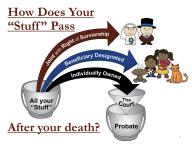
4.         Check the beneficiary designations of your accounts.  The beneficiary is the person who would receive the proceeds of the account at your death.  Is the beneficiary your estate?  If so, why did you make your estate the beneficiary?  Having your estate as the beneficiary pretty much ensures that your estate will have to be probated.  Is your beneficiary under the age of 18 or someone with special needs?  It may not be the best thing to give someone under the age of 18 a large inheritance.  Although the court will put protections in place for those under 18, those protections can be expensive and once the beneficiary has their 18th birthday, the money is all theirs – to spend however they wish. Yikes!

             If the beneficiary has special needs, a gift may mean they lose governmental benefits.

            Distributions from IRA’s and 401(k)’s have income tax consequences, so have you considered how your beneficiary designations will affect the tax liability of your beneficiaries?

5.         Make an appointment with an estate planning lawyer, a CPA and your financial advisor.  A good, comprehensive plan involves a group of professionals who can guide  and counsel you in making decisions about your estate. 

Will you accept thechallenge to make getting your New Years Goal getting your affairs in order?

Here's to a great new year!


Twitter Facebook Digg Delicious Email LinkedIn Stumble Upon

Permanent Link

write a comment

Sunday, December 04, 2011

Medicare: Treat it as Part of Your Financial Plan


Medicare changed things up a bit this year by scheduling open enrollment early.  Because Medicare is in the news, I’ve been getting a lot of calls from clients to ask me about Medicare. While most people understand that they can become eligible for Medicare when they turn 65, they wonder about the types of Medicare plans available, and what plan they should choose.  Today, we’ll talk a little bit about the basics of Medicare, and about how to choose a Medicare Part D prescription drug plan.

Here is the basic Medicare alphabet:

Medicare Part A covers hospital insurance that can help pay for inpatient care at hospitals, skilled nursing facilities, hospice, and home health care.

Medicare Part B covers medically-necessary service such as doctor’s services, outpatient care, home health services, and some other services.  You will pay a premium to be covered by Part B.

Medicare Part C is a Medicare Advantage Plan.

Medicare Part D is the prescription drug coverage.

In order to become eligible for Medicare, you must be age 65, or you must have been receiving Social Security Disability benefits for 24 months.  Most people who are on Social Security or Railroad Retirement benefits will automatically get Medicare Part A and B starting on the first day they turn 65, or when they have completed the full 24 months after beginning to receive Social Security Disability.  One exception is that if you have ALS – Lou Gehrig’s disease- you are eligible for Part A and B in the month your disability begins.

Every year, for those who are qualified for Medicare, there is an open enrollment time when you have the ability to sign up for a new Medicare Part C or Part D plan. 

Normally, the open enrollment period begins in January.  However, this year the open enrollment period began on October 15 and ends on December 7.  If you want to know when to enroll in Social Security Part A and Part B, and when to enroll in Part C and Part D here is a handy chart:  http://www.medicare.gov/Publications/Pubs/pdf/11219.pdf

Medicare Part D is probably the most confusing of the Medicare Alphabet Programs.  Medicare Part D is the program that offers prescription drug coverage to those who are qualified for Medicare.  In order to get the drug coverage, an eligible person must join a plan.  The plans are run by private insurers or other private companies approved by Medicare.

Medicare Part D is available if you are otherwise-eligible for Medicare A & B.  If you don’t enroll in Part D when you become eligible, you might have to pay a slight penalty when you do join at a later date.  You can enroll in two basic types of plans:  Medicare Prescription Plans or Medicare Advantage Plans.  The Medicare Advantage Plans are usually HMO’s or PPO’s that give you all of your Part A and B coverage, and in addition may give you drug coverage.  If you choose another Part D plan while already enrolled in a Medicare Advantage Plan that offers a drug plan, you may become disenrolled from your HMO or PPO plan and returned to regular Medicare.

How can you choose the right Medicare Part D plan?  The plans are run by private insurance plans, or private companies, and the cost of the plan is generally based on the prescriptions you use, the “formulary” of the plan, and whether you go to a pharmacy that is within your plan’s network.  The formulary is the list of drugs that a Medicare plan covers.

The Medicare.gov website is full of information about the plans that are available, and is also full of advice on how to choose a plan.  To choose a plan, you can enter your zip code and your prescriptions in the formulary finder on Medicare’s website.  http://plancompare.medicare.gov/pfdn/PlanFinder/DrugSearch.  The plan finder will then give you a list of providers and will tell you the cost of the plan and the cost of the drugs.  You can then call the providers with any questions you might have.

Erica Dumpel, with Czajkowski Dumpel & Associates, Inc. http://cdainc.net/ an experienced healthcare plan advisor, emphasizes that you should research the plans on a yearly basis.  If you have a number of prescriptions, hunting down the right plan can take a lot of time – but can also save you a significant amount of money each year. 

If you miss this year’s open enrollment period, or if you decide not to change plans, be sure to put a reminder on your calendar to review your plan again next year.  In fact, I recommend that you schedule a yearly financial and legal checkup, which should include a thorough review of all of your insurance premiums, co-pays and prescription costs.

Will you start treating your Medicare Plan as part of your Financial Plan?


Twitter Facebook Digg Delicious Email LinkedIn Stumble Upon

Permanent Link

write a comment

Sunday, July 31, 2011

Caring for Children with Special Needs: Combating Autism Reauthorization Act of 2011

 Caring for Children with Special Needs

Combating Autism Reauthorization Act of 2011

You can’t turn on the television or radio without hearing about the negotiations – or lack of negotiations- in Congress regarding the looming budget crisis.  We are all concerned about whether our elected representatives in Washington can come to a compromise that will help the country out of the current debt crisis.  Of great concern to those of us who work with families who have family members with special needs is whether, and how, the few programs left to support these families will be affected.

Assuming Congress gets through these negotiations and gets back to work on other  important issues, Congress has the opportunity to address a significant issue that the United States faces today.  That issue is that the number of persons diagnosed as being on the Autism spectrum is increasing at an alarming rate.  It is estimated that 1.5 million Americans are currently on the Autism spectrum.  That number is expected to increase by 10-17% annually. 

A growing concern is that the number of autistic children entering adulthood is also increasing rapidly.   By 2023, the number of autistic children entering adulthood is estimated to be 380,000.  The cost of care for these adults is said to be around $27 million, or about the budget of the state of Tennessee. 

On August 3, 2011, the U.S. Senate Committee on Health, Education, Labor and Pensions (HELP) is scheduled to meet for hearings on the Reauthorization of the Combating Autism Act, originally passed in 2006.  The Combating Autism Act allocated $950 million dollars over the five year period for the Centers for Disease Control (CDC), National Institutes of Health (NIH), and other governmental agencies to conduct research on the autism spectrum.  The Act required the Director of NIH to develop and implement a strategic plan for autism research.  If the Act is not reauthorized by September 30, 2011, the federal commitment will disappear.

The current bill, named the Combating Autism Reauthorization Act (CARA), would allocate the federal funding of $1billion and create a National Institute of Spectrum Disorders Research within the NIH.

If CARA is not passed, research on the spectrum will likely be thrown into disorder.  We cannot afford to let this bill die.  Research into the reasons for the disorders on the spectrum, and especially research into treatment and therapies, is crucial. 

If you would like to find out more about CARA, and how you might be able to help make sure this Act is passed, see http://www.autismvotes.org/site/c.frKNI3PCImE/b.6376831/k.ACFC/CARA.htm.


Twitter Facebook Digg Delicious Email LinkedIn Stumble Upon

Permanent Link

write a comment

Sunday, July 10, 2011

Planning For a Loved One With Special Needs

 If the last few years have taught us anything, it is that life is not predictable.   The economic crash seemed to come out of nowhere.  The weather appears to be totally weird and unpredictable, with tornadoes and floods occurring with fierce and dangerous intensity.

So, too, our health and physical wellbeing are not entirely predictable.  Despite our best efforts to eat healthy food and exercise regularly, we can have a car accident or suffer a bad reaction to medication and become ill or disabled.

For some of us, our financial resources and health insurance may not be enough to cover our care needs.  When that happens, we sometimes have to seek governmental assistance to provide for our healthcare.

Many of my clients had no idea they would end up depending on Supplemental Security Insurance (SSI) or Medicaid for assistance, but those progams can be a lifeline for those with disabilities and longterm care needs.

How can we plan for our loved ones and family members who are on governmental assistance programs?  How can we provide for their needs without jeopardizing their public benefits programs?

One way is to establish a special needs trust for the benefit of the person with a disability.  A special – or supplemental needs trust, as I’ll call it- is an entity established to hold assets so that those assets are available for  the needs of the person with a disability that are not provided by the governmental benefit.  The person with the disability is not the trustee, does not own the assets, and cannot control the assets, so the assets aren’t counted for purposes of qualifying for benefits.

SSI and Medicaid generally restrict the recipient of those programs from having more than about $2,000 in assets, but the assets in the trust aren’t calculated in that $2,000.  Most of the time, the trust is established by a parent or grandparent, but If the assets did not belong to the person with a disability to begin with, anyone can establish the supplemental needs trust and anyone can contribute assets to that trust.  The trust can be the recipient of gifts or inheritance.

We’ve discussed how to choose a trustee in previous blogposts,

http://bit.ly/rfPKWc  but for a supplemental needs trust I usually recommend appointing a professional trustee to manage the assets in the trust.  The intricacies of public benefits programs can be daunting for most people, so even though they charge for the management,  professionals with experience with supplemental needs trusts can save money in the long run.

So, even though life seems unpredictable, you can at least plan for some of the supplemental needs of your loved one with a disability.


Twitter Facebook Digg Delicious Email LinkedIn Stumble Upon

Permanent Link

write a comment

Sunday, July 03, 2011

When Bridget Came To Visit: On Being Prepared

 When Bridget came to visit, she wanted to take my blue and white teacups home with her.  They were shiny and pretty, and fit in her hand just perfectly.  Dick promised they would go to the mall and buy some teacups just like them.

Bridget was in the mid to late stages of Alzheimer’s disease when she and Dick first visited my office.  Dick, a wonderful, patient husband and caregiver to Bridget, was determined to be prepared for whatever legal and financial zingers might hit the couple.  Years before, after Bridget was first diagnosed with Cognitive Memory Impairment, Dick and Bridget had prepared living trusts, powers of attorneys, and healthcare directives.  They came to me to make a few changes to Dick’s living trust and financial power of attorney.   I always recommend that clients update advance directives and powers of attorney to avoid having someone decide that the documents are “stale” and, therefore, not valid.  We prepared new advance directives for Bridget and Dick.  On the day Bridget came to sign, she could not remember that the children whom she had nominated as agents were adults.  In fact, I’m really not sure she could remember who her children were.

With sadness, I told Dick that Bridget could not sign any documents that day.  We agreed to try another day, since those with dementia often have times when they are very alert, and other times when they are not.  Bridget never was able to sign her new advance directive, and soon went to stay in a wonderful memory care facility.   The health care and financial proxies she had already signed worked fine for her, and Dick was able to make her healthcare and financial decisions without any challenges.

Susan, on the other hand, had never executed advance directives for healthcare, financial powers of attorney, or any wills or trusts.  She didn’t think she needed to, since her husband made most of the financial decisions for the couple.  Her family did not push her to do any planning, since they thought it would upset her.  When I visited Susan at the nursing home after her husband died, she told me the nurses were stealing her underwear, she no longer recognized her family members, and she wondered why I was visiting her at work.   Susan swore like a sailor, and insisted that she would not sign “any g. . d. . . papers”, believing that I was trying to steal from her, too.

As a result, her family had to spend months and thousands of dollars to seek guardianship and conservatorship of Susan, a court proceeding which is expensive financially and emotionally for all involved. 

Many folks with Alzheimer’s and other dementias become paranoid and distrustful.  When they hit that stage, it is extremely difficult to get them to agree to do advance directives, financial powers of attorney, or wills.  Why would they agree to sign something that they believe allows folks to steal from them?

As an attorney, I preach that every adult needs to have an advance directive for healthcare, a financial power of attorney, and at least a basic will.   In Susan’s case, her fear of planning led to heartache and hardship for her family.   Could all of this expense and difficulty have been avoided by visiting an attorney’s office while Susan was able to plan for her and her family’s future?

As a footnote, I want to tell you all about Dick, Richard J. Farrell, whom I mentioned above.  Dick has written a book Alzheimer’s Caregiving about his life with Bridget, joys and trials of caregiving, and about his grief when Bridget died after living with Alzheimer’s for nearly 20 years.  Check out his website at www.alzheimerscaregivingbook.com to see how you can order a copy.


Twitter Facebook Digg Delicious Email LinkedIn Stumble Upon

Permanent Link

write a comment

Sunday, June 26, 2011

Elder Abuse - It's Right Under Your Nose

 Sometimes bad things happen right under our noses, and we don’t want to – or can’t – see.  Elder abuse is like that – we can’t – or don’t want to admit that we see it.

June 15th was Elder Abuse Day, a day intended to draw our attention to a problem that is often ignored. The term “elder abuse” is often in the news, but what exactly is elder abuse?

The World Health Organization defines elder abuse as “a single, or repeated act, or lack of appropriate action, occurring within any relationship where there is an expectation of trust which causes harm or distress to an older person.”

Elder abuse is not confined to the poor.  Mickey Rooney, the 90-year-old actor, has accused his 52-year-old stepson of abusing him and taking his money.  He testified before Congress about the growing problem of elder abuse.  

Just last week, I learned of two events which I characterize as elder abuse. 

The daughter of my client, Fred, used the Financial Power of Attorney her father had granted her to transfer almost all of his money into her own bank account.  Before she accomplished this feat, though, she had carefully isolated him from other relatives, friends, and even from me, his attorney.  The assisted living facility (ALF) where he lived was instructed not to allow him to see or talk with a laundry list of people.  In fact, almost everyone he knew was on that list.  The daughter was heard to swear at him, and call him foul and demeaning names.  She neglected to take him to the optometrist and audiologist, with the result that he could not hear or see, and was diagnosed with dementia. 

The other case also involved the caregiver daughter.  She physically abused her mother, and also transferred her mother’s money into her own account.

In both of the cases I described, the elder parent trusted their adult child to care for them in their time of need.  My client, Fred, had only one child, and he hoped and believed he could trust her completely.  He was sure that she had his best interests at heart when she told him that she would help him manage his money and would watch out for all of his healthcare needs.

Fred’s daughter had two documents that she used inappropriately to take advantage of Fred.  She used the fact that she had been named as his agent under an Advance Directive to limit access to her father, and she used a Financial Power of Attorney to transfer all of Fred’s money out of his bank accounts.

What can be done to help elders in these situations?  In Fred’s case, the signs were missed by those around him.  The ALF should have been suspicious of the daughter’s attempts to limit visits and phone calls from friends and relatives.  People in assisted living facilities are presumed to have the capacity to make their own decisions about whom they will visit.  ALF’s should respect the resident’s rights to communicate with whomever they wish, unless the resident has a guardian appointed by a court of law. Here is a link to an article by the State Bar of Georgia on Long-term care residents’ rights:  http://bit.ly/pt9Gjc

Those who witnessed the daughter call him names, could have intervened to ask Fred if he needed help or could have reported the daughter to Adult Protective Services.  Here is a link to the website for DHS:  http://bit.ly/nw3jSw

Sometimes we have to be willing to see things we don’t want to see.

Twitter Facebook Digg Delicious Email LinkedIn Stumble Upon

Permanent Link

write a comment

Sunday, June 19, 2011

Trust Me - Who Should Be My Trustee?


Once I convinced my client, Mary, that a trust is a safe, and not so scary, way to protect herself and her stuff during any incapacity, she wanted to know who could possibly serve as a backup trustee?   According to Mary, her daughter was a kind and loving person who would do everything she could to support her mother, but her daughter’s financial skills were somewhat suspect.  Mary’s son is a busy family man with a great job, but he seems too busy to help Mary now.

Who could she choose? 

First, what does a trustee do exactly?  A trustee is a fiduciary, which means that he or she has a legal or ethical duty regarding the management of property for another.  Although a trustee may have either the duty to manage the trust assets or the duty to distribute those assets, many trustees both manage and distribute.  A trustee is usually responsible for investing the assets in the trust, distributing those assets to the beneficiaries according to the trust terms, and making sure any required accountings are prepared and that taxes are paid when necessary.

A trustee can be an individual who is a family member or friend.  Parents often want their children to succeed them as trustee.  When deciding whether to have a child as a successor trustee – or when choosing which child – be sure to be realistic about your adult child’s financial abilities.  Make sure that the person you choose understands that the trust will be managed for the benefit of beneficiaries – and that the trustee might not be one of those beneficiaries.  Be aware that a trustee might have a conflict of interest if the trust assets will eventually pass in part or whole to the trustee or his or her family members.  Also, it is best not to choose someone who has financial problems such as large debts, a failing business, or a looming bankruptcy.  Someone with financial issues might be tempted to borrow or use trust assets for his or her own benefit, despite the terms of the trust.

A trustee can also be a professional individual, like a lawyer or CPA, who can be hired to serve as a trustee.  Trustees may charge a percentage of the assets in the trust, or an hourly fee for any time spent administering the trust.

Of course, a bank or trust company may also serve as a trustee.  Generally, a bank or trust company will have a trust department and will hire employees to serve as Trust Officers with primary responsibility for administering the trusts.  The bank or trust company will charge a fee – usually a percentage of trust funds – to serve in that capacity.  Many banks and trust companies will only serve as a trustee if the assets in the trust are whatever minimum amount the bank or trust company deems appropriate for their business.

You can also choose co-trustees who will work together to administer the trust.  Sometimes it makes sense to have a professional or corporate trustee along  with a family member.  In that case, the family member’s role might be to make sure the professional or corporate co-trustee is aware of the needs of the beneficiary and is making investment and distribution decisions appropriate to the circumstances.

The best way to choose a trustee is to start with a list of relatives, friends, business or professional people you know, and banks and trust companies, and think hard about their ability to manage money.  Think about their character and ethics, and choose the best from that list. 

Twitter Facebook Digg Delicious Email LinkedIn Stumble Upon

Permanent Link

write a comment


Previous Posts

Happy 2012! Make Getting Your Affairs in Order Your Goal for the New Year

Holiday Traditions: Really Check in With Your Neighbors and Relatives

Medicare: Treat it as Part of Your Financial Plan

Paying for Long-term Care: VA Benefits for Surviving Spouses

Minor Guardianships: Letters of Instruction In Case of the Unimaginable

Naming Guardians for Minor Children

Protecting People with Special Needs: Guardianship of Young Adults

Caring for Children with Special Needs: Combating Autism Reauthorization Act of 2011

Planning For a Loved One With Special Needs

When Bridget Came To Visit: On Being Prepared

Blog Categories

Advance Directives

Aid & Attendance

Alzheimer's

autism

Book Review

caregivers

Cognitive Memory Impairment

elder abuse

Elder Law

Estate Planning

Finance

General Legal

Guardianship

Letter of Instruction

Long-term care

Medicaid

Medicare

Medicare

Minor Children

Money

Older drivers

Prescription Drug Plan

Probate Court

special needs

special needs

Special Needs, Medicaid, SSI

Surviving Spouse

Trusts

VA Benefits

Veterans

Veterans

Veterans Benefits

Wills

Blog Links

Archived Posts

2012
2011

The Elrod-Hill Law Firm assists clients with Estate Planning, Elder Law, Probate / Estate Administration, Special Needs Planning and Pet Trusts in Georgia area including Norcross doraville and chamblee.


© 2012 The Elrod-Hill Law Firm | Disclaimer
3930 E. Jones Bridge Rd., NW, 160, Norcross, GA 30092 | Phone: 770-416-0776

Estate Planning | Elder Law | Probate / Estate Administration | Special Needs Planning | Pet Trusts | Advanced Estate Planning | Guardianships | M E D I C A I D | VETERANS BENEFITS | Seminar Brochures | Special Needs Planning

Attorney Website Design by
Amicus Creative