|
Tuesday, October 4, 2022
 I just got back from a trip to the beach where there were back-to-back weddings near the ocean. So many new brides and grooms! Are you planning to get married or divorced in the near future? How will that affect your estate plan?
An estate plan has lots of pieces and moving parts, but let’s start with how marriage and divorce affect the basic legal documents you should have in your estate plan.
WHAT HAPPENS TO MY OLD WILL?
If you marry after signing a will and you have not specifically stated in the document that you are executing the will in anticipation of a future marriage, that will signed previous to marriage will not be valid. If you then die without executing a new will, you will die intestate and the rules of the state of Georgia will control distribution of your assets. That means that if you have a wife and children, your new spouse will share the assets in your probate estate with your children. Read more . . .
Monday, October 3, 2022
 If a person dies without a will, they are said to have died “intestate”. When that happens, the person’s assets will be passed to the heirs based on the rules that Georgia’s intestate succession rules. The probate process for a person who is intestate is called an administration and the person named to take care of your estate after your death is called an administrator. The administrator will file a petition in the probate court, and once appointed and sworn in by the judge, the administrator will first pay the debts of the estate and then make distributions to the living heirs of the deceased person. - If you have a spouse but no children, the spouse will get the entire estate;
- If you have children, but no spouse, your children will divide the estate equally.
Read more . . .
Wednesday, September 14, 2022
 Mary, an independent, strong-willed woman all of her life, realized that she might need help managing her finances. She came to me with concerns that her memory might be slipping a little, and she was afraid that she might forget to pay her bills. After assuring her that she was fine, I encouraged her to consider placing her assets in a trust so that she could write her own rules for management of those assets. Mary was skeptical. “Trusts are way too complicated for me! I don’t even know what a trust is. Read more . . .
Wednesday, June 8, 2022
Phew! I’ve reached that point in life where I can relax – not much, but a little- because both of my children are adults and, for the most part, out of the nest. Until just a couple of years ago, I broke out in a sweat every time I had to go out of town on business by myself. Not only did I worry about whether my kids would get fed, get their homework done and make it to soccer practice on time, but I also worried about what would happen to them if I had an accident and didn’t make it home. If you have minor children, children under the age of 18, I’m sure you worry about that, too. If you are not around, who will feed them, help them with their homework and get them to soccer practice? Choosing someone to care for your children is difficult. Read more . . .
Wednesday, February 10, 2021
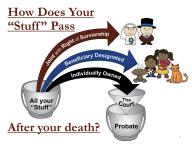 What should you do when a loved one dies? How and when does the estate get administered? Administration is defined as Court-supervised distribution of an estate during probate. Also used to describe distribution process for a trust. Probate means proving the will, but it can also be used to indicate a court process to handle a deceased person’s estate. When a loved one dies, there is often confusion and panic about what legal and financial steps should be taken by survivors. There may be little information about the finances of the decedent, and spouses or children are left to sort through what may seem like a never-ending mass of papers. Read more . . .
Monday, December 28, 2020
 An heir is the person or persons who are related by blood that would inherit from a decedent ( a person who has died) if the decedent had no will. An heir is the person or persons who are related by blood that would inherit from a decedent ( a person who has died) if the decedent had no will.
A beneficiary is a person (or charity or institution) named in a will to whom the decedent wishes to leave his or her assets at the time of death.
Who are your heirs? Take your wrist and place two fingers on your other hand and place them on your wrist. Do you feel a pulse? If so, you don’t yet have any heirs. That is kind of a snarky way to explain that we cannot know who your heirs are until you are dead.Read more . . .
Wednesday, March 18, 2020
 While we don’t believe that anyone should panic, we do want to encourage anyone with older or immuno-compromised loved ones to be prepared.
The CDC is encouraging everyone to have extra food and supplies on hand, in the event of sudden closures or quarantines. Please take the time to check on any seniors or people in your life who are ill/disabled to see if they need help getting things together. Key items to gather include: Prescriptions and any over-the-counter medications Those with breathing problems should ensure that any devices they use (nebulizer, oxygen) are working properly and they have enough medication on hand to power any devices. A two-week supply of food Drinks with electrolytes in the event the flu or another illness is contracted Nutrition drinks such as Ensure for seniors Lysol, disinfecting agents, and anti-bacterial soap Extra toilet paper Pet food for at least two weeks Adult diapers, feminine products, and any other necessary supplies
Finally, it’s a wise idea to make copies of your loved one’s insurance cards and make sure that you can put your hands on any Powers of Attorney and Healthcare Directives that would allow you to legally communicate with doctors and make financial and medical decisions on your loved one’s behalf. Read more . . .
Friday, February 7, 2020
 My favorite hobby is reading and I try to combine my love of reading with my profession of estate planning. The plots of some of my favorite books are about dysfunctional family relationships complicated by really bad estate planning!Here are three books I recommend where siblings were torn apart by their parents’ bad estate planning choices.The Nestby Cynthia D’Aprix SweeneyThe four siblings of the Plumb family - Leo, Melody, Beatrice, and Jack- are the beneficiaries of a trust fund they call “The Nest” left to them by their father. The terms of the trust provide that the trust assets will be distributed equally to the four siblings when the youngest, Melody, reaches age 40. When the book begins, Melody is fast-approaching her 40th birthday, and each of the siblings is anxiously awaiting the distribution that could solve their self-inflicted life problems.
Read more . . .
Monday, June 26, 2017
To help your parents get their affairs in order, you should first make sure that you or someone trustworthy has the legal ability to manage your parent’s affairs. This article is a guide to the four fundamental legal documents you and your parent may need in order to get financial affairs in order. Read more . . .
Thursday, July 16, 2015
 July is Sandwich Generation Awareness Month. The Sandwich Generation refers to those people, mostly in their mid-40’s to late 50’s, who are caring for aging parents as well as caring for young children or dependent young adult children. If you are the meat or peanut butter in that sandwich, you might be looking for help from your siblings or other family members. One of the best ways to plan the care for an aging or disabled family member is by holding a family meeting. The meeting is designed to do many things: get information from the aging or disabled person about their needs, figure out what kind of care is needed and brainstorm about ways to find that care, gauge the financial resources available for care, and assign duties to various family members so that one caregiver does not get burned out. Read more . . .
Monday, March 18, 2013
Come join us at the Tapestry House of Alpharetta Tuesday, March 26th at 6:30pm.
Patti will be speaking about the difference between being housebound with a caregiver vs moving into an Assisted Living Facility.
All are welcome!
The Elrod-Hill Law Firm,LLC assists clients with Estate Planning, Veterans Benefits, Medicaid, Elder Care Law, Probate, Special Needs Planning and Pet Trusts in the North Atlanta area including the counties of Dekalb, Gwinnett and Fulton.
|

|
|
|