ABOUT OUR FIRM CONTACT US

Finance

Monday, January 09, 2012

Happy 2012! Make Getting Your Affairs in Order Your Goal for the New Year


Each year, I make a list of goals that I want to accomplish for the year.  Some years, the goals have a theme – unfortunately, the theme is almost always the same:  lose weight, exercise more. . .

This year, I’m challenging you to make one of your New Year’s goals to get your estate planning affairs in order.  This is one goal that is easy to accomplish – I promise!

Here are 5 easy steps you can take to accomplish this goal.

1.         Get educated about estate planning.  Attend an estate planning workshop or two.  Estate planning attorneys like me are always giving seminars and workshops to educate people about estate planning.  Yes, these workshops help attorneys attract clients, but the goal of these workshops is really to educate people about the basics of estate planning so clients can have meaningful conversations and can make thoughtful decisions about their own estates. 

2.         Review your old documents.  Do you have a will or trust?  Advanced Directives or Healthcare Powers of Attorney and Living Wills?  Do you have a Durable Financial Power of Attorney?  How old are your documents?  If your wills name guardians for your children who are now 30 years old, your documents are definitely out of date.  Did you name an executor who is now dead or is your ex-wife named as your executor?  Probably time to revise your will. 

            What about your health care documents? If they were done in Georgia before 2007, you may want to update them to the Advance Health Care Directive that went into effect in 2007.  Who have you named to make healthcare decisions for you?  Is that person still the right person to make decisions for you?           

3.         Look at the ownership of all of your accounts.  How is your bank account titled?  Title indicates who owns the account.  Are you the sole owner or is it a joint account?  Who is the joint owner and is this someone who should be a joint owner of your account?  Here’s a link to a blog I wrote last year about the pros and cons of joint ownership of accounts:  http://bit.ly/xm8W5o

4.         Check the beneficiary designations of your accounts.  The beneficiary is the person who would receive the proceeds of the account at your death.  Is the beneficiary your estate?  If so, why did you make your estate the beneficiary?  Having your estate as the beneficiary pretty much ensures that your estate will have to be probated.  Is your beneficiary under the age of 18 or someone with special needs?  It may not be the best thing to give someone under the age of 18 a large inheritance.  Although the court will put protections in place for those under 18, those protections can be expensive and once the beneficiary has their 18th birthday, the money is all theirs – to spend however they wish. Yikes!

             If the beneficiary has special needs, a gift may mean they lose governmental benefits.

            Distributions from IRA’s and 401(k)’s have income tax consequences, so have you considered how your beneficiary designations will affect the tax liability of your beneficiaries?

5.         Make an appointment with an estate planning lawyer, a CPA and your financial advisor.  A good, comprehensive plan involves a group of professionals who can guide  and counsel you in making decisions about your estate. 

Will you accept thechallenge to make getting your New Years Goal getting your affairs in order?

Here's to a great new year!


Twitter Facebook Digg Delicious Email LinkedIn Stumble Upon

Permanent Link

write a comment

Tuesday, December 20, 2011

Holiday Traditions: Really Check in With Your Neighbors and Relatives

On Friday night, we gathered with neighbors old and new to celebrate a cherished tradition – our annual progressive dinner.  Traditionally, we begin the year.  We find out about the new babies, weddings and graduations to come.  We learn what colleges the children will attend, and where soon-to-be college graduates will start their careers.  We also check in on aging neighbors to find out about their health scares, their difficulties, the loss of their loved ones.  After moving from house to house for salads, and main courses, we end up with more wine and sweet treats to reminisce about dinners past.  How many have we had?  No one can remember.  But by the end of the evening, we’re looking forward to next year’s dinner, and assigning tasks to make it happen.

Continuing this tradition is important to my family and my neighborhood because it allows us to connect with our neighbors, to get to know them when times are good so that we can help each other when times are not so good.  Without our traditional yearly gathering, we might not realize when our neighbors need our help.

In my practice, I see many people who see their aging or ill family members and friends at the holidays and realize that all is not well.  Sometimes, all has not been well for so long that those family members are now in crisis.

If you are visiting family members who are aging or ill, take the time to talk with them to find out about their health.  Are they seeing a doctor?  What medications are they taking?  How do they keep track of their medications on a daily basis?  Ask them if they have a healthcare proxy or advance directive for healthcare?  Who will make healthcare decisions for them if they are not able?

Although it can be difficult to have a conversation with parents about their finances, ask them if they have appointed someone to make financial decisions for them if they are not able.  Look around the house and see if there are stacks of unopened bills.  Find out if they have long-term care insurance.  Ask where their important financial and legal documents can be found.  If they haven’t appointed anyone to make decisions for them, urge them to do that while they still can.

If your aging family members are still driving, ride with them to see if they are still able to drive safely.  Are they stopping at the stop signs?  Do they forget to look before making a turn?  Do they still remember how to get to places they have been to many times before or do they forget where they are going?  If they are having trouble driving, would a driving school help?  Or, can you help them find transportation so they won’t need to drive anymore?

With married couples, try to talk with each one alone.  Sometimes couples get so good at covering for each other, you don’t realize that one of them might be suffering from dementia.  If one of the couple is ailing, find out how the well spouse is coping.  Is he or she eating and sleeping right?  Is he or she getting help in the home so he or she can get out to see friends, or just get some time to rest and recharge?

Look in the refrigerator, freezer and cupboard.  Is the food in the refrigerator or cupboards moldy or out of date?  Are they going to the grocery store on a regular basis?  If you suspect that they are not eating right, is there a meals-on-wheels program that they might qualify for?

I hope that you will enjoy holiday traditions with family, friends, and neighbors this year.  Will you take time to talk with your family and friends to see whether they might need help in the coming year?

Happy Holidays!

Patti Elrod-Hill


Twitter Facebook Digg Delicious Email LinkedIn Stumble Upon

Permanent Link

write a comment

Sunday, December 04, 2011

Medicare: Treat it as Part of Your Financial Plan


Medicare changed things up a bit this year by scheduling open enrollment early.  Because Medicare is in the news, I’ve been getting a lot of calls from clients to ask me about Medicare. While most people understand that they can become eligible for Medicare when they turn 65, they wonder about the types of Medicare plans available, and what plan they should choose.  Today, we’ll talk a little bit about the basics of Medicare, and about how to choose a Medicare Part D prescription drug plan.

Here is the basic Medicare alphabet:

Medicare Part A covers hospital insurance that can help pay for inpatient care at hospitals, skilled nursing facilities, hospice, and home health care.

Medicare Part B covers medically-necessary service such as doctor’s services, outpatient care, home health services, and some other services.  You will pay a premium to be covered by Part B.

Medicare Part C is a Medicare Advantage Plan.

Medicare Part D is the prescription drug coverage.

In order to become eligible for Medicare, you must be age 65, or you must have been receiving Social Security Disability benefits for 24 months.  Most people who are on Social Security or Railroad Retirement benefits will automatically get Medicare Part A and B starting on the first day they turn 65, or when they have completed the full 24 months after beginning to receive Social Security Disability.  One exception is that if you have ALS – Lou Gehrig’s disease- you are eligible for Part A and B in the month your disability begins.

Every year, for those who are qualified for Medicare, there is an open enrollment time when you have the ability to sign up for a new Medicare Part C or Part D plan. 

Normally, the open enrollment period begins in January.  However, this year the open enrollment period began on October 15 and ends on December 7.  If you want to know when to enroll in Social Security Part A and Part B, and when to enroll in Part C and Part D here is a handy chart:  http://www.medicare.gov/Publications/Pubs/pdf/11219.pdf

Medicare Part D is probably the most confusing of the Medicare Alphabet Programs.  Medicare Part D is the program that offers prescription drug coverage to those who are qualified for Medicare.  In order to get the drug coverage, an eligible person must join a plan.  The plans are run by private insurers or other private companies approved by Medicare.

Medicare Part D is available if you are otherwise-eligible for Medicare A & B.  If you don’t enroll in Part D when you become eligible, you might have to pay a slight penalty when you do join at a later date.  You can enroll in two basic types of plans:  Medicare Prescription Plans or Medicare Advantage Plans.  The Medicare Advantage Plans are usually HMO’s or PPO’s that give you all of your Part A and B coverage, and in addition may give you drug coverage.  If you choose another Part D plan while already enrolled in a Medicare Advantage Plan that offers a drug plan, you may become disenrolled from your HMO or PPO plan and returned to regular Medicare.

How can you choose the right Medicare Part D plan?  The plans are run by private insurance plans, or private companies, and the cost of the plan is generally based on the prescriptions you use, the “formulary” of the plan, and whether you go to a pharmacy that is within your plan’s network.  The formulary is the list of drugs that a Medicare plan covers.

The Medicare.gov website is full of information about the plans that are available, and is also full of advice on how to choose a plan.  To choose a plan, you can enter your zip code and your prescriptions in the formulary finder on Medicare’s website.  http://plancompare.medicare.gov/pfdn/PlanFinder/DrugSearch.  The plan finder will then give you a list of providers and will tell you the cost of the plan and the cost of the drugs.  You can then call the providers with any questions you might have.

Erica Dumpel, with Czajkowski Dumpel & Associates, Inc. http://cdainc.net/ an experienced healthcare plan advisor, emphasizes that you should research the plans on a yearly basis.  If you have a number of prescriptions, hunting down the right plan can take a lot of time – but can also save you a significant amount of money each year. 

If you miss this year’s open enrollment period, or if you decide not to change plans, be sure to put a reminder on your calendar to review your plan again next year.  In fact, I recommend that you schedule a yearly financial and legal checkup, which should include a thorough review of all of your insurance premiums, co-pays and prescription costs.

Will you start treating your Medicare Plan as part of your Financial Plan?


Twitter Facebook Digg Delicious Email LinkedIn Stumble Upon

Permanent Link

write a comment

Sunday, November 20, 2011

Paying for Long-term Care: VA Benefits for Surviving Spouses


 When she was approaching her 85th birthday, Sarah began to worry.  Until that time, she believed she had plenty of money to last through her lifetime.  Now, she saw her life’s savings slipping away.

It started when she realized she was forgetting things.  First, she forgot to pay her utilities, and didn’t realize it until the power company threatened to turn off her power.  Next, she was driving to the grocery store and forgot how to get back home.  After that nice young man called her son to ask him where Sarah lived so he could help her get home, her son demanded that she give up her car keys.  Once she gave up the car keys, she had to hire someone to take her to the grocery store and to the doctor.  When she burned the soup on the stove, her family made her hire a caregiver to come in for eight hours every day.   Sarah’s family was now talking about moving her into an assisted living facility so that she could be safe at night.

For the first time in her life, Sarah was spending more than her income every single month.  She was dipping into her savings each month to pay the caregiver, and that scared her.

VA “Death Pension” for Surviving Spouses

When Sarah and her children came to see me, I told them that Sarah, the widow of a World War II veteran, could qualify for a Veteran’s Pension for surviving spouses – called a “Death Pension.”  In 2012, when the VA makes a cost of living adjustment, the Death Pension can pay up to $1094.00 each month to the surviving spouse of a veteran who served during wartime.

The requirements for the Death Pension are that the veteran had to have served for 90 days on active duty, one day of which was during a declared war.  The veteran had to have been discharged with an honorable, general, or medical discharge.  The surviving spouse must have been married to the veteran for at least one year preceding death,  still married at the time of  death, and not remarried after the death.

There are some asset and income limitations, too.  The asset limitations are not hard and fast, and depend on each individual circumstance.  For most cases, the surviving spouse must have less than about $50,000 in his or her name, not including the car, the home, and the personal property inside the home.  The VA uses a life expectancy chart and considers other information, such as cost of care, to determine acceptable asset amounts, so the VA can use a different asset limit for each applicant.  Although assets can be transferred to achieve eligibility, I recommend that people see an attorney before doing any transfers.  Asset transfers can affect Medicaid eligibility, and improper transfers can cause serious difficulties down the road.

The Death Pension is a three level pension, and the amount a surviving spouse may be eligible for depends on the level of care required.  The basic pension is available to a surviving spouse over the age of 65, who otherwise meets the income and asset limitations.  In 2012, the top rate for the basic Death Pension will be about $684.00 per month.

A higher level of pension is available to someone who is classified as “Housebound”.  The VA defines housebound as being substantially confined to the home or immediate premises due to a disability that will likely remain throughout the claimant’s lifetime. In 2012, a surviving spouse with no dependent children who is housebound is eligible for benefits of up to $837 per month. 

The highest level of pension, referred to as Aid and Attendance, is available when a surviving spouse requires the assistance of another person to perform activities of daily living, or is blind or nearly so, or is a patient in a nursing home.  That monthly rate in 2012 will be about $1094.00.

Income Limitations

Income limitations apply, but the definition of income for VA purposes is all of the income received by the person applying for the benefit, minus recurring unreimbursed medical expenses.  In Sarah’s case, her only income was her monthly Social Security plus a little bit of interest income she received on her savings.  Every month, Sarah was spending her entire Social Security check, plus some of her savings, to pay for a caregiver to come into the home.  So, for VA purposes Sarah had no income and, based on the fact that she now needed the assistance of another person on a regular basis, Sarah could qualify for the highest level of the Death Pension. 

If Sarah decides to move into an assisted living facility, the cost of that facility will be considered an unreimbursed medical expense, too.

The process of applying for benefits can be daunting, and a decision from the VA can take quite a few months.  However, once an application is filed, if the applicant is qualified, the benefit will be retroactive to the first day of the month following the application and the surviving spouse can get a lump sum for all of the months it has taken the VA to make that decision.

Sarah was relieved to know about the VA benefit and that $1094.00 each month will allow her to pay for homecare for a while longer, until she decides whether she wants to go into an assisted living.  Then, that money, along with her social security, will allow her to choose a good and safe facility.


Twitter Facebook Digg Delicious Email LinkedIn Stumble Upon

Permanent Link

write a comment

Sunday, July 03, 2011

When Bridget Came To Visit: On Being Prepared

 When Bridget came to visit, she wanted to take my blue and white teacups home with her.  They were shiny and pretty, and fit in her hand just perfectly.  Dick promised they would go to the mall and buy some teacups just like them.

Bridget was in the mid to late stages of Alzheimer’s disease when she and Dick first visited my office.  Dick, a wonderful, patient husband and caregiver to Bridget, was determined to be prepared for whatever legal and financial zingers might hit the couple.  Years before, after Bridget was first diagnosed with Cognitive Memory Impairment, Dick and Bridget had prepared living trusts, powers of attorneys, and healthcare directives.  They came to me to make a few changes to Dick’s living trust and financial power of attorney.   I always recommend that clients update advance directives and powers of attorney to avoid having someone decide that the documents are “stale” and, therefore, not valid.  We prepared new advance directives for Bridget and Dick.  On the day Bridget came to sign, she could not remember that the children whom she had nominated as agents were adults.  In fact, I’m really not sure she could remember who her children were.

With sadness, I told Dick that Bridget could not sign any documents that day.  We agreed to try another day, since those with dementia often have times when they are very alert, and other times when they are not.  Bridget never was able to sign her new advance directive, and soon went to stay in a wonderful memory care facility.   The health care and financial proxies she had already signed worked fine for her, and Dick was able to make her healthcare and financial decisions without any challenges.

Susan, on the other hand, had never executed advance directives for healthcare, financial powers of attorney, or any wills or trusts.  She didn’t think she needed to, since her husband made most of the financial decisions for the couple.  Her family did not push her to do any planning, since they thought it would upset her.  When I visited Susan at the nursing home after her husband died, she told me the nurses were stealing her underwear, she no longer recognized her family members, and she wondered why I was visiting her at work.   Susan swore like a sailor, and insisted that she would not sign “any g. . d. . . papers”, believing that I was trying to steal from her, too.

As a result, her family had to spend months and thousands of dollars to seek guardianship and conservatorship of Susan, a court proceeding which is expensive financially and emotionally for all involved. 

Many folks with Alzheimer’s and other dementias become paranoid and distrustful.  When they hit that stage, it is extremely difficult to get them to agree to do advance directives, financial powers of attorney, or wills.  Why would they agree to sign something that they believe allows folks to steal from them?

As an attorney, I preach that every adult needs to have an advance directive for healthcare, a financial power of attorney, and at least a basic will.   In Susan’s case, her fear of planning led to heartache and hardship for her family.   Could all of this expense and difficulty have been avoided by visiting an attorney’s office while Susan was able to plan for her and her family’s future?

As a footnote, I want to tell you all about Dick, Richard J. Farrell, whom I mentioned above.  Dick has written a book Alzheimer’s Caregiving about his life with Bridget, joys and trials of caregiving, and about his grief when Bridget died after living with Alzheimer’s for nearly 20 years.  Check out his website at www.alzheimerscaregivingbook.com to see how you can order a copy.


Twitter Facebook Digg Delicious Email LinkedIn Stumble Upon

Permanent Link

write a comment

Sunday, June 19, 2011

Trust Me - Who Should Be My Trustee?


Once I convinced my client, Mary, that a trust is a safe, and not so scary, way to protect herself and her stuff during any incapacity, she wanted to know who could possibly serve as a backup trustee?   According to Mary, her daughter was a kind and loving person who would do everything she could to support her mother, but her daughter’s financial skills were somewhat suspect.  Mary’s son is a busy family man with a great job, but he seems too busy to help Mary now.

Who could she choose? 

First, what does a trustee do exactly?  A trustee is a fiduciary, which means that he or she has a legal or ethical duty regarding the management of property for another.  Although a trustee may have either the duty to manage the trust assets or the duty to distribute those assets, many trustees both manage and distribute.  A trustee is usually responsible for investing the assets in the trust, distributing those assets to the beneficiaries according to the trust terms, and making sure any required accountings are prepared and that taxes are paid when necessary.

A trustee can be an individual who is a family member or friend.  Parents often want their children to succeed them as trustee.  When deciding whether to have a child as a successor trustee – or when choosing which child – be sure to be realistic about your adult child’s financial abilities.  Make sure that the person you choose understands that the trust will be managed for the benefit of beneficiaries – and that the trustee might not be one of those beneficiaries.  Be aware that a trustee might have a conflict of interest if the trust assets will eventually pass in part or whole to the trustee or his or her family members.  Also, it is best not to choose someone who has financial problems such as large debts, a failing business, or a looming bankruptcy.  Someone with financial issues might be tempted to borrow or use trust assets for his or her own benefit, despite the terms of the trust.

A trustee can also be a professional individual, like a lawyer or CPA, who can be hired to serve as a trustee.  Trustees may charge a percentage of the assets in the trust, or an hourly fee for any time spent administering the trust.

Of course, a bank or trust company may also serve as a trustee.  Generally, a bank or trust company will have a trust department and will hire employees to serve as Trust Officers with primary responsibility for administering the trusts.  The bank or trust company will charge a fee – usually a percentage of trust funds – to serve in that capacity.  Many banks and trust companies will only serve as a trustee if the assets in the trust are whatever minimum amount the bank or trust company deems appropriate for their business.

You can also choose co-trustees who will work together to administer the trust.  Sometimes it makes sense to have a professional or corporate trustee along  with a family member.  In that case, the family member’s role might be to make sure the professional or corporate co-trustee is aware of the needs of the beneficiary and is making investment and distribution decisions appropriate to the circumstances.

The best way to choose a trustee is to start with a list of relatives, friends, business or professional people you know, and banks and trust companies, and think hard about their ability to manage money.  Think about their character and ethics, and choose the best from that list. 

Twitter Facebook Digg Delicious Email LinkedIn Stumble Upon

Permanent Link

write a comment

Sunday, June 05, 2011

Trust Me, It's Like A Little Red Wagon


Trust Me, It's Like A Little Red Wagon

Mary, an independent, strong-willed woman all of her life, realized that she might need help managing her finances.  She came to me with concerns that her memory might be slipping a little, and she was afraid that she might forget to pay her bills.  After assuring her that she was fine, I encouraged her to consider placing her assets in a trust so that she could write her own rules for management of those assets.  Mary was skeptical.  “Trusts are way too complicated for me!  I don’t even know what a trust is. And who would be the trustee?” 

I explained that a trust is very much like that little red wagon you had when you were a kid.   I have a picture of my sister hauling me around in a red Radio Flyer wagon when I was about three years old, and I remember using that wagon to cart my Barbie dolls to the neighbor’s house.  I also remember that I was the boss of that wagon, and would only let my best friend, Paula, touch that wagon and the Barbies in it.

So, how is a trust like that wagon?

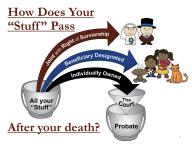
A wagon is a receptacle – a place to put your “stuff”.  When you were a kid, you probably put all of your important toys, and things you found by the side of the road, inside that wagon.  You took the handle of the wagon and pulled the “stuff” wherever you wanted it to go.  You could take things out of the wagon, or put new things in the wagon, whenever you wanted.  When you got tired, you put down the handle.  If you wanted, you could allow someone else to take the handle and haul your stuff for you.  You made the rules for your wagon.

A trust is like that.  You put your assets – your adult “stuff” – in the trust.  While you are alive and well, you can be the trustee.  The trustee is the person that puts the stuff in the trust, makes sure the stuff in the trust is taken good care of, and takes the stuff out of the trust whenever necessary.  When you no longer want to be the trustee, or you can no longer serve as trustee because of incapacity or death, someone else will pick up the handle and serve as the trustee. 

As the trust maker, you get to decide the rules of the trust.  Just like you could decide who got to pull your wagon, you get to decide who will be the trustee.  You can also decide who will benefit from the things in that trust and when they can benefit. 

Unlike the rules you made up as a child, though, the rules of the trust are written in a document so that the person serving as trustee knows the rules and must legally follow those rules. 

In the next blog post, I’ll discuss how to decide who should be the trustee – who can pull your little red wagon.

Twitter Facebook Digg Delicious Email LinkedIn Stumble Upon

Permanent Link

write a comment

Sunday, May 22, 2011

Alternatives to the Joint Account: The Pros and Cons of a Power OF Attorney

 ALTERNATIVES TO THE JOINT ACCOUNT:

THE PROS AND CONS OF A POWER OF ATTORNEY


So, if you’re telling me not to put my daughter on my accounts, what are the alternatives?  How can I be sure I will have someone to take care of my financial affairs if I’m not able to?

In my last post, I told the story of Mary and her daughter, Nancy.  I pointed out the pitfalls to having adult children – or other people- as joint owners on real estate and bank accounts.  I promised I would share some alternatives to joint accounts.

One alternative is to appoint someone as an agent under a financial power of attorney.  The agent is authorized to make financial decisions for you if you are not able to make decisions – or if you just don’t want to make those decisions any more.  A financial power of attorney can be for a one-time transaction – like buying or selling your home – or it can be for any and all financial transactions.  A financial power of attorney should be durable, meaning that it will still be in effect even if you no longer have the mental capacity at the time of the transaction.  

Some advantages are that if you become suddenly incapacitated, you have someone with the legal authority to step in and make your financial decisions while you are incapacitated.  In addition, if you are okay but just need  someone to help you make sense of information, your agent can discuss your financial affairs with your insurance company, your financial institutions or your CPA.  Your agent can then explain the information and help you understand  so that you can make your own decisions. You can also appoint an agent under power of attorney to have authority to sign checks for you if you need some help paying your bills.

What are some downsides to the financial power of attorney?  We sometimes call a power of attorney document a “blank check.”  When you appoint someone as your agent under power of attorney, you are giving them lots of power with no instructions on how to use that power.  Imagine giving someone a blank check and telling them to go out and buy you a house without telling them where you want to live or how much you have to spend.  Chances are that person would buy a house in a neighborhood where you had no desire to live at a price you couldn’t afford.  Giving someone the authority to spend your money without giving them instructions can be frustrating and dangerous for both you and your agent.

Another downside is that the financial power of attorney dies when you do. The agent under a financial power of attorney has absolutely no legal authority to handle your finances after your death.  That means that upon your death, there is no one with the legal authority to deal with your finances, and your family must often wait until the probate court judge appoints someone to administer your estate before they can access your bank accounts.

I generally recommend that clients have an agent named in a durable power of attorney for finances, but I also warn them to have a discussion with the agent about when it is appropriate to use the power, and to point out the limits of that power.

In my next post, we’ll talk about another alternative to the joint account – the living trust.


Twitter Facebook Digg Delicious Email LinkedIn Stumble Upon

Permanent Link

write a comment

Saturday, May 14, 2011

Should I Add My Daughter to My Account?

Should I Add My Daughter to My Account?


Mary and her daughter, Nancy, were very close.  Mary was still able to make all of her financial decisions, and paid all of her bills on time each month.  Keeping a high bank balance gave Mary comfort that she would be able to access money whenever she needed it.  She was worried that she might “lose it” at some point, so she asked Nancy to become a signer on her bank account.  She and Nancy became joint owners of Mary’s bank account, although Nancy acknowledged that her mother was the real owner of that money.

Nancy was not quite as meticulous about her finances as her mother.  She had used the overdraft protection on her bank account on many occasions when she forgot to record her purchases in her check register, or when she needed something and didn’t have the money to pay for it.  Nancy’s bank account was in the same bank as the account she and Mary owned together.

One day, Nancy overdrew her bank account by a significant amount.  Per the rules of the bank, money was withdrawn from the joint account of Mary and Nancy.

When Mary checked her account online, she was horrified.  What had happened to her money?  She could not imagine how her bank balance had gotten so low and raced to the bank to get to the bottom of what was obviously the bank’s mistake.  When the bank employee explained that the money had been transferred to Nancy’s account to cover an overdraft, Mary was horrified.  She had no idea that by letting Nancy become a joint owner of her account, she had given Nancy the right to use all of her money. Mary immediately closed the account and transferred her money to another bank.

 Nancy had no idea that her mother would be liable for her overdraft, and was ashamed that her mother knew about her bad money habits.  Over time, she was able to pay her mother back.

Many older clients tell me they want to add their children to their accounts and to their real estate.  They tell me that they do that so they can avoid probate, and so that their children will be able to manage their money for them should they become incapacitated.

I rarely recommend joint accounts for people who are not married or in a committed relationship.  There are a couple of reasons why I think it is usually a very bad idea.  First, just as with Mary and Nancy, the assets in a joint account are deemed to be owned equally by either party and are available to the creditors, predators, and ex-spouses of both parties.  Second, at the death of a joint account owner, the asset belongs to the surviving joint owner.  Most of my clients have more than one child, and their wills almost always leave everything equally to each of their children.  Yet, when they jointly own an asset with only one child, that asset belongs to that child alone at the time of the death.  You may be relying on the generosity of the surviving child to share the proceeds with his or her siblings.  If there are more than two joint owners, the asset belongs to whomever is the last man standing. That means that if one child predeceases the parent, the asset will belong to the surviving child when the parent dies. Since most of my clients intend for their grandchildren to inherit their deceased parent’s share, this type of planning usually defeats the intent.

 Finally, the joint owner can take the whole asset whenever she wants because a joint owner can withdraw the entire amount in the  account without the consent of the other owners. 

In my next post, I’ll talk about ways to manage money during incapacity and avoid probate without using jointly owned accounts.Should I add my daughter to my account?


Twitter Facebook Digg Delicious Email LinkedIn Stumble Upon

Permanent Link

write a comment


Previous Posts

Happy 2012! Make Getting Your Affairs in Order Your Goal for the New Year

Holiday Traditions: Really Check in With Your Neighbors and Relatives

Medicare: Treat it as Part of Your Financial Plan

Paying for Long-term Care: VA Benefits for Surviving Spouses

Minor Guardianships: Letters of Instruction In Case of the Unimaginable

Naming Guardians for Minor Children

Protecting People with Special Needs: Guardianship of Young Adults

Caring for Children with Special Needs: Combating Autism Reauthorization Act of 2011

Planning For a Loved One With Special Needs

When Bridget Came To Visit: On Being Prepared

Blog Categories

Advance Directives

Aid & Attendance

Alzheimer's

autism

Book Review

caregivers

Cognitive Memory Impairment

elder abuse

Elder Law

Estate Planning

Finance

General Legal

Guardianship

Letter of Instruction

Long-term care

Medicaid

Medicare

Medicare

Minor Children

Money

Older drivers

Prescription Drug Plan

Probate Court

special needs

special needs

Special Needs, Medicaid, SSI

Surviving Spouse

Trusts

VA Benefits

Veterans

Veterans

Veterans Benefits

Wills

Blog Links

Archived Posts

2012
2011

The Elrod-Hill Law Firm assists clients with Estate Planning, Elder Law, Probate / Estate Administration, Special Needs Planning and Pet Trusts in Georgia area including Norcross doraville and chamblee.


© 2012 The Elrod-Hill Law Firm | Disclaimer
3930 E. Jones Bridge Rd., NW, 160, Norcross, GA 30092 | Phone: 770-416-0776

Estate Planning | Elder Law | Probate / Estate Administration | Special Needs Planning | Pet Trusts | Advanced Estate Planning | Guardianships | M E D I C A I D | VETERANS BENEFITS | Seminar Brochures | Special Needs Planning

Attorney Website Design by
Amicus Creative